
Kessho Craft Chocolate: The Story Behind Austin’s International Chocolate Sensation
In Focus: Kesshō Craft Chocolate
I’ve certainly tasted my fair share of chocolate over the past decade and a half since starting Chocolate Connoisseur. That includes cacao origins from all across the cacao belt, and some very unconventional flavor combinations – some that worked incredibly well, while others, not so much. Still, we always applaud the effort.
What I’d yet to see until now, however, is a chocolate maker like the one I’m about to introduce you to here, one who receives both the applause and the accolades. Kesshō is amazingly adept at playing with flavors that at times may sound completely incompatible.
Just yesterday I heard yet another person tell me that Kesshō is their favorite chocolate maker right now, this time from an up-and-coming local maker here in Phoenix. So chocolate lovers, hear this: when it comes to Kesshō Craft Chocolate, the award-winning hype is real.
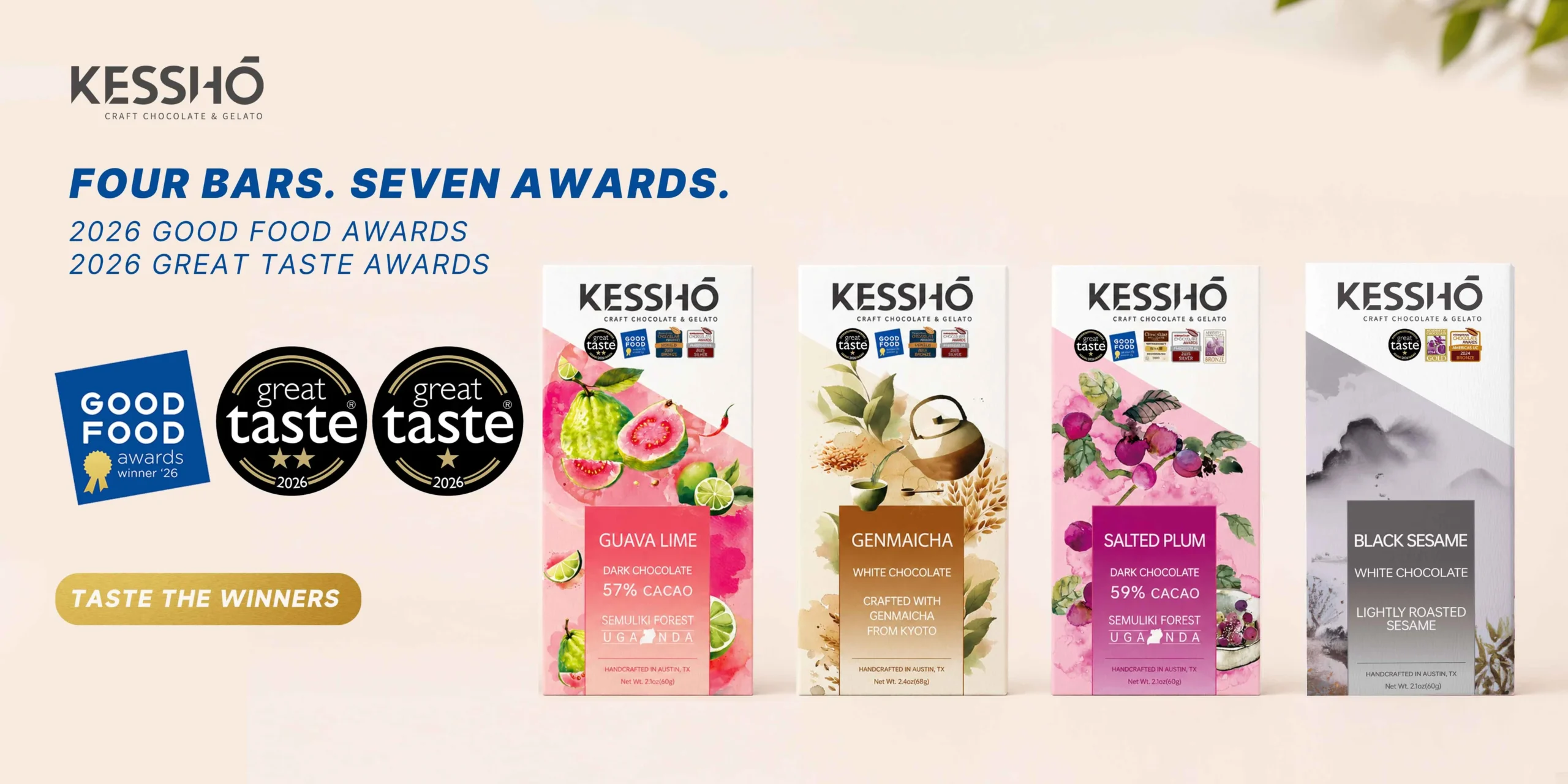
These four bars had an incredible 2026
Today I’ll take you on a journey that includes everything from Guava Lime to Salted Plum… from Jasmine Yuzu to Black Sesame Sunflower… and even from a Lamb Skewer bar (no lambs were harmed!) to Lychee Rose.
So settle in for a long yet blissful read, as we dive deep into the truly wonderful world of Kesshō Craft Chocolate.
Beijing Beginnings
Kesshō’s co-founder, Liang Wang, was born and grew up in Beijing, China, and much of her background from Beijing makes it way into Kesshō’s ultra unique chocolate recipes.
Liang credits her grandmother, Mo, as one of the most prolific influences in her life. As a foreign language teacher (both English and Russian) with Japanese heritage, who lived in six different Asian countries no less, Mo helped raise her, revealing a world of possibility all along the way.
She loved learning languages so much that she spoke French and Japanese as well, leading by example and empowering Liang to see the larger world around her. Mo also taught Liang another crucial lesson, however – she encouraged her to focus on the things she felt passionate about, as knowing that in doing so, Liang could keep her faith in life and survive through any difficult times ahead (long before 2020 even entered the picture).
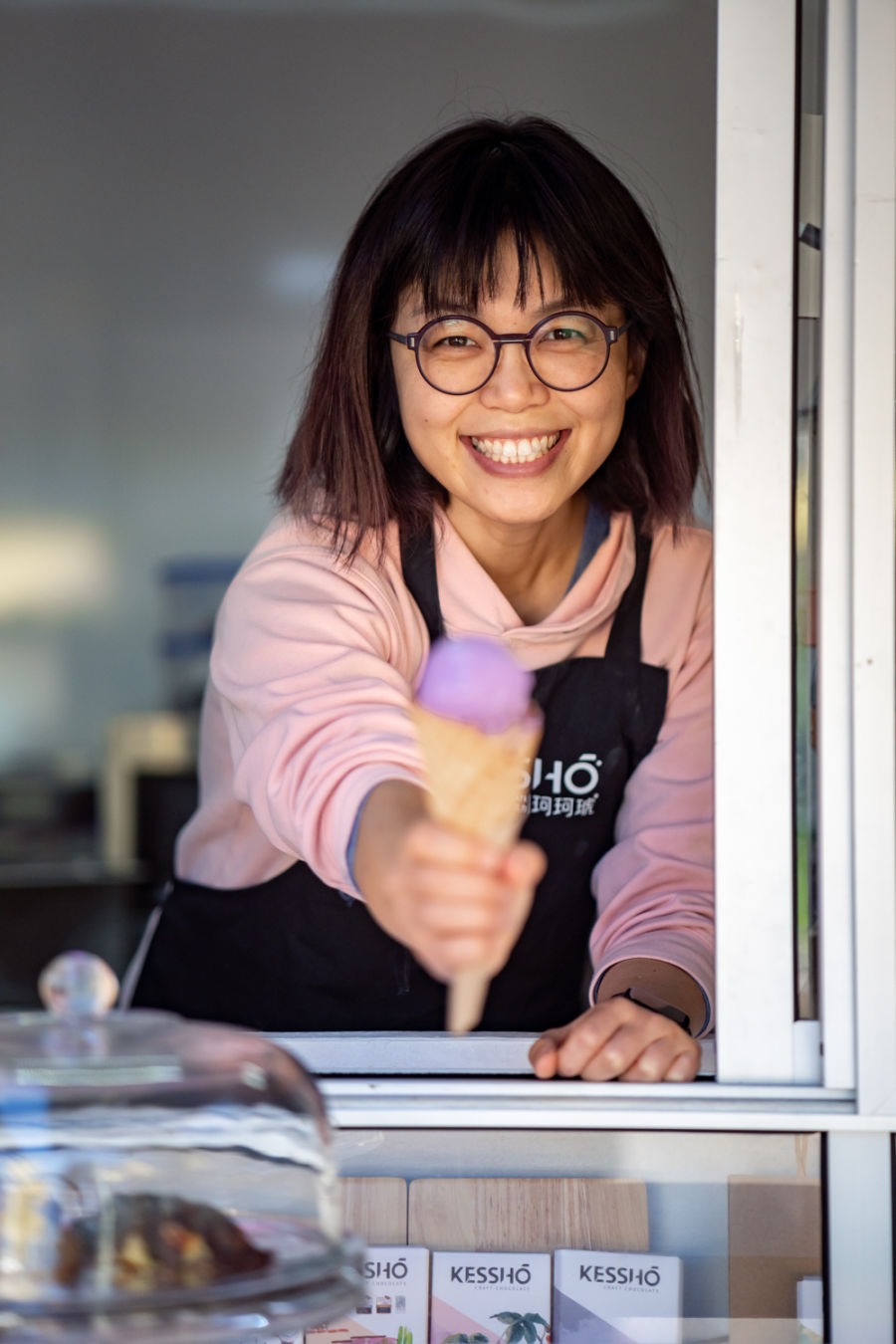
Liang serves a gelato cone at one of Kesshō Craft Chocolate & Gelato’s Trucks
Growing up in China, the mainstream thoughts were certainly not to choose your hobby as your profession, but Mo always disagreed and supported Liang in discovering and pursuing true passions in life, even when Liang was quite young.
“I greatly appreciate what my grandmother taught me, and how she always encouraged my ever-growing interest in languages, cultures, and sweets. She meant so much to me.”
Although Liang didn’t know it at the time, another cultural influence simply came from so many family members living overseas while she grew up in Beijing. Whenever someone visited, from all across the globe – Japan, USA, France – they brought chocolate with them as a gift. At an early age, Liang subtly saw the wondrous power of chocolate: the smiles it could readily put upon people’s faces.
As she affectionately notes, it holds a special place in her heart versus other treats –
“Chocolate is more than something sweet. It carries the local culture and good blessings, too.”
Peking Serendipity
Despite her grandmother’s encouragement to follow a passion, Liang’s initial career path instead sent her to Tsinghua University in Beijing to study biology. Although biology was by no means a passion, her grandmother taught at Tsinghua and even lived on the campus for a time, so Liang felt a deeper motivation than simply pursuing a degree.
She was soon about to discover how life has a funny way of steering in you the right direction regardless…
Near the end of her time at Tsinghua, Liang met eventual Kesshō co-founder and business partner Mark Huetsch via a mutual friend, and the seeds of Kesshō were quietly planted. Mark, originally from southern Illinois, was studying at Peking University, and together they quickly discovered a mutual interest in promoting culturally meaningful products, especially pastries. That fateful introduction, a perfectly subtle bit of serendipity, started the long culinary journey together for Liang and Mark.
In addition to the twist of fate, Liang also reflects back fondly on her time studying biology. It helped more than she initially realized –
“I appreciated the scientific approach I learned at Tsinghua. Making chocolate and conducting biology experiments are similar. Both require a lot of repetition, changing one variable at a time, using control groups… things like that.
So despite the very different path on paper, my time at the university helped a lot in the long run.”
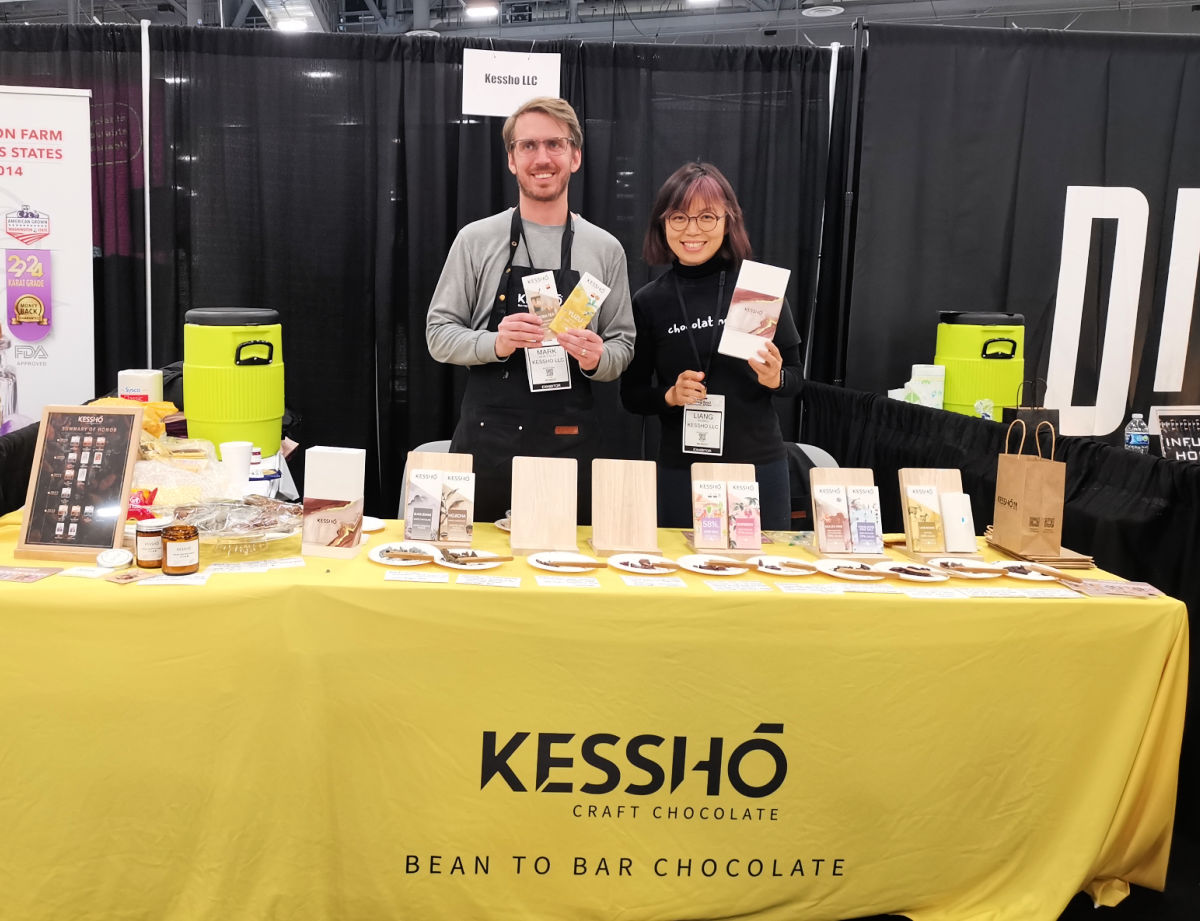
Kesshō co-founders Mark Huetsch and Liang Wang at the NWCF
Mark also held a scientific background coupled with a passion for great food. Before attending Peking, he studied computer science and Chinese Studies at Stanford, and thanks to his Midwest upbringing on a farm, he preferred food connected to the earth, with nothing over-processed. He loved to experiment with food and ingredients.
Five years after first meeting in college, Mark and Liang started their first business together.
American Pie
The culinary duo founded Pie House in Beijing back in 2009, baking American pies from their kitchen, introducing American culture to their neck of the woods via hearty, warm, delicious pies. Gradually they expanded to pastries, introducing more regional Chinese and Japanese ingredients and upgrading the brand name to Pantry’s Best, as they merged East Asian flavors into other American baked goods. Liang notes –
“Our work brought together Asian ingredients and Western pastry techniques. Through Pantry’s Best, we spent years exploring how Asian ingredients could work in Western-style desserts.”
In 2017, she took a break from running the bakery and spent a few months in south India, and it’s here that she started to learn about bean to bar chocolate, a pivotal moment in the birth of Kesshō.
While living in Mysuru, a culturally rich city in southern India, she visited an organic food store and stumbled upon some surprisingly expensive chocolate bars for sale –
“They were unusually high priced for what I normally saw in India, so I asked the proprietor, ‘what’s so special about this for it to be so expensive, especially with so few ingredients?’
Well, the bars were crafted from premium Indian chocolate, with locally grown cacao, and the first one I tried changed my world. I can still remember the flavors… it was quite fruity, with mango, passionfruit, soursop… all of these tasting notes breaking through in a simple, 72% dark bar with only a few ingredients. I was shocked.”
So Liang reached out to the owner of the brand, called Earth Loaf, and scheduled a visit to their local chocolate factory, intending to bring Earth Loaf to China. On her visit, they told her the entire story behind the bar… working with farmers, working with fermentation, etc.
In the end, however, they couldn’t sell outside of the immediate area, due to logistical shipping issues from the heat that saw no easy solution. Instead, they encouraged Liang to learn more and start making her own – truly a life-altering moment.
That epiphany led Liang and Mark to fully transition all the industrial chocolate at Pantry’s Best over to bean to bar chocolate, and their chocolate making journey had officially begun in earnest.
They sat in a very unique position here too, as Mark had attended Stanford with Simran Bindra from Kokoa Kamili – they were college classmates, graduating the same year. Liang elaborates –
“Once we decided we wanted to change all the chocolate at Pantry’s Best over to ethically-sourced bean to bar, Mark reached out to Simran. We soon became the first importer of Kokoa Kamili beans in China, also the first time we imported any ingredients directly from origin. So we had the privilege of starting our bean to bar journey using Kokoa Kamili cacao.”
With the chocolate inspiration slowly burning, Liang went to study pastry and baking at Le Cordon Bleu in Tokyo, spending six months refining her pastry and chocolate skills.
That training, alongside the practical experience of developing products and running Pantry’s Best, set the stage for Mark and Liang’s next evolution, “as the liveliness and possibility of cacao flavors made us decide to dive deeper into the chocolate world,” Liang adds.
They started crafting bean-to-bar chocolate in 2018, which opened up a new path for flavor exploration.
“Tea, sesame, citrus, and preserved fruit… each one brings something different to a chocolate recipe, while the cacao itself supplies a distinct character to each creation.
We wanted to make chocolate that reflected our own backgrounds and the foods we enjoyed.”
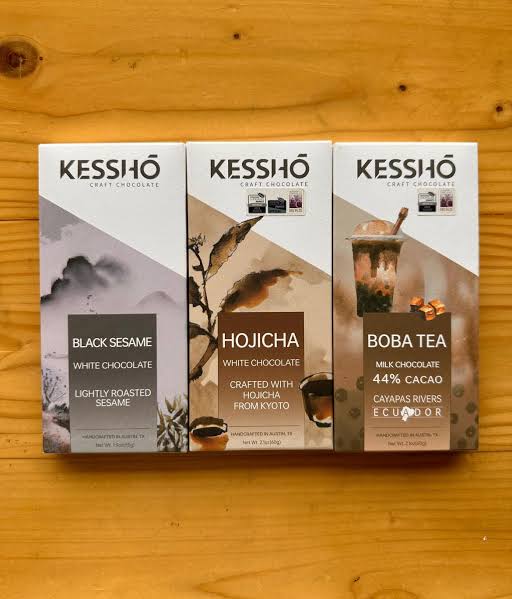
One of the first chocolate bars they ever crafted – a 58% Tanzanian dark milk chocolate – won both an ICA award and AOC award, before they even decided to spin off a chocolate brand. The surprising awards supplied a great boost in confidence for their whole team, as they started to realize they may indeed hold the potential of crafting world-class chocolate.
From Shanghai to Austin
Mark and Liang officially founded Kesshō in Shanghai in 2019. Their enthusiasm to explore multiple cacao origins quickly hit a snag, however, when they discovered the hard way that mainland China only maintains a very small whitelist for cacao importation. They purchased several different varieties from Emily at Uncommon Cacao – excited to start working with cacao from Ecuador, Bolivia, and Guatemala – but the shipment never arrived in China, as some of those countries weren’t on China’s whitelist.
After a little investigation, they soon learned that testing the different cacao origins they sought would require relocating to Hong Kong, a free trade zone in China. The pandemic reared its ugly head right around this time, however, which quickly altered their course. Mark decided he really wanted to live closer to his family again, plus Liang and he both realized there were too many obstacles blocking their hopes of selling chocolate in the USA while still based out of China.
Their search in the states eventually led them to Austin, which won out for affordability versus California. Mark really wanted sunshine (I get it, Midwest roots will do that to you), plus Liang hit her limit for quarantines, so the time had come to start a new chapter. Mark moved to Austin in late 2021, Liang moved in early 2022, and then in late 2022 they found the perfect location to get started.
Heading into Spring 2023, Kesshō sat poised for their first full chocolate-making season in their new Texas kitchen!
Austin, We Have Liftoff…
Although Kesshō entered the American chocolate world with two coveted awards already in tow, Liang and Mark still felt quite uncertain how people would respond to Asian-inspired chocolate bars in Austin, Texas. With a commissary kitchen in place and a food truck (at one of Austin’s very popular food truck locations) on the horizon later in the year, it felt like they had a lot on the line.
Liang recalls the experience, with much relief –
“Thankfully, the launch went relatively smoothly, and the Austin community offered plenty of support very early on.”
How smoothly? They opened the food truck in September of 2023, and just six months later opened up a second one in March of 2024. Kesshō’s American arrival moved quickly.
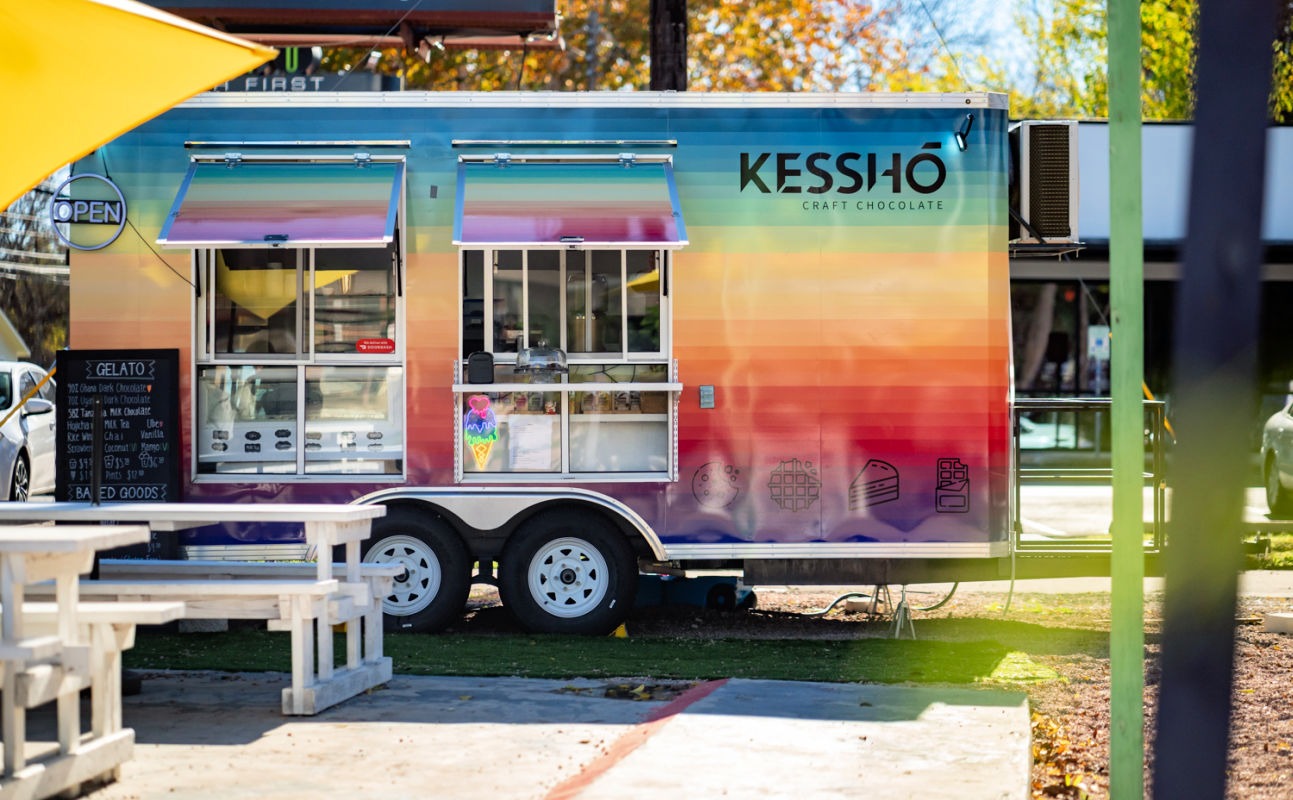
Kesshō makes a summer day even better
Kesshō’s first dessert truck opened in the Bouldin Creek neighborhood, where the local food and beverage community helped Mark and Liang navigate the early difficulties. The neighborhood association did an interview with Liang, highlighting her entrepreneurial journey… neighbors would invite Kesshō to their potluck dinners… Liang even set up membership discounts with some neighboring businesses, including a really popular workout studio called HEAT.
It didn’t take very long for Kesshō to settle in. Similar to what we see here in Phoenix, however, the summer heat in Austin can also take a toll on chocolate makers. It forced Liang and Mark to adapt and answer the all-important question – what do you do when life gives you melted chocolate?
The answer, but of course, is to make gelato!
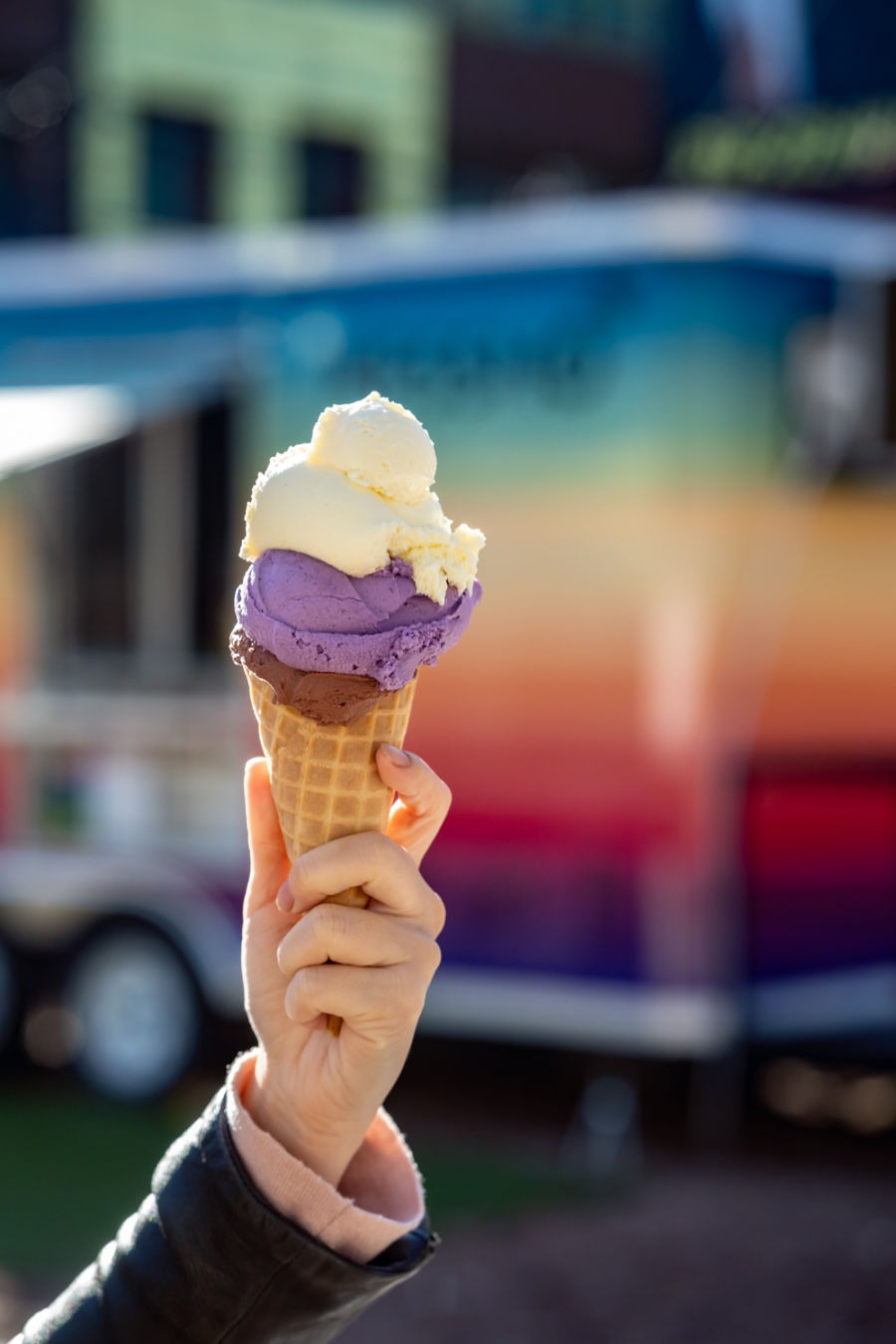
A triple scoop of Kesshō’s Gelato
In Kesshō’s case, they turned melted chocolate into single-origin gelato, crafting incredible frozen desserts with their patented Asian fusion, including hojicha tea. By the time they launched their very first food truck, they were selling both chocolate and gelato together. Liang adds –
“Gelato gives us another way to think about the same ingredients. An ingredient behaves differently in a frozen dessert than it does in a chocolate bar. That makes developing the two categories very interesting, as each one requires its own process.”
Hojicha? Horchata?
Still, great start or otherwise, Liang recalls plenty of interesting customer encounters along the way, especially when they were selling at events or demoing their chocolate at stores. One memory sticks out the most, however – when they launched Kesshō in Austin’s Central Market, a Co-Op type of grocery store similar to Whole foods, but with a much more local flair.
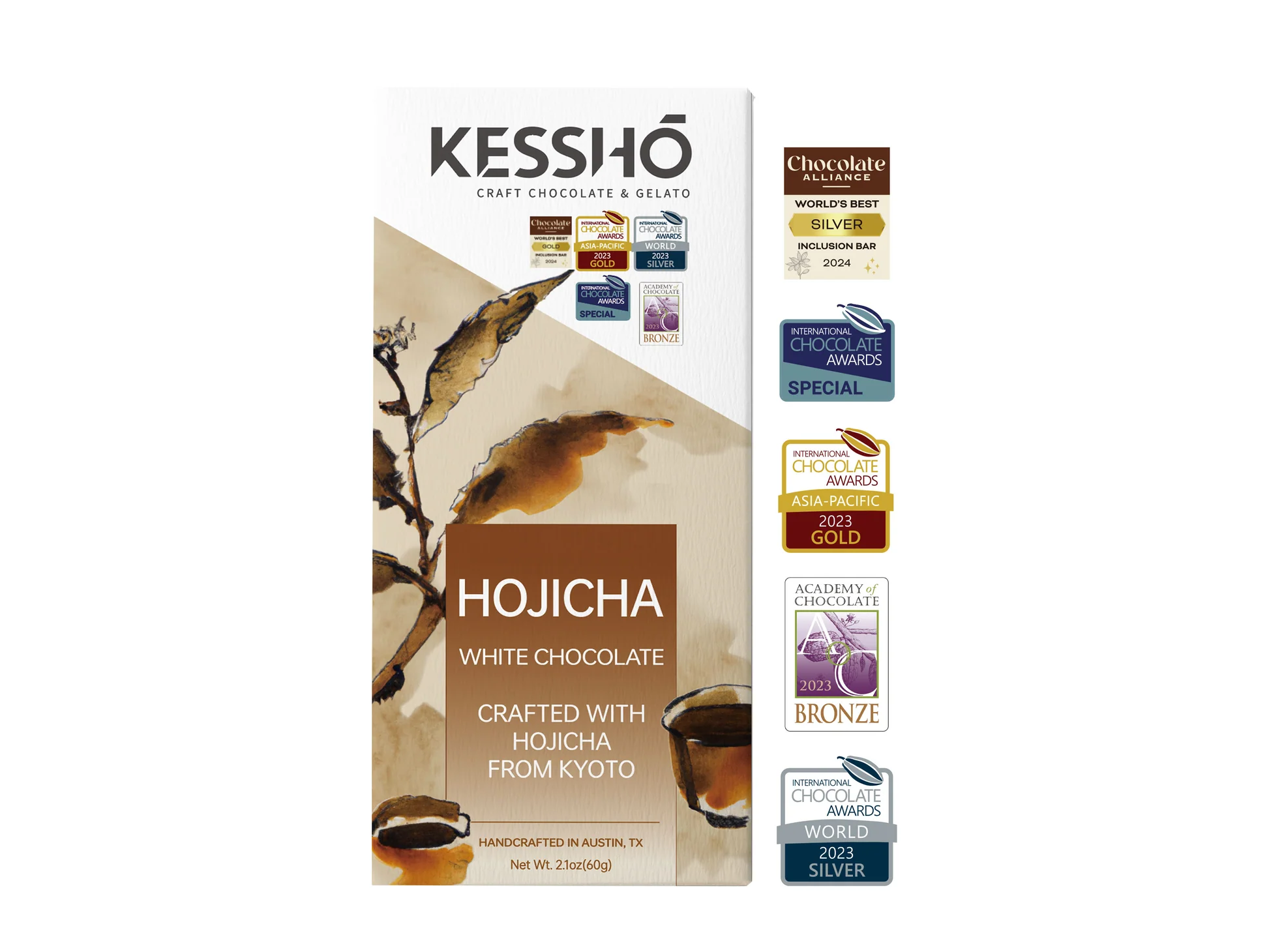
One bar leads to another…
Before moving to Austin, Liang had never lived or studied in the States, let alone spent any time in Texas. Everything felt brand new to her, with plenty to learn about local culture. Case in point here: horchata. Liang explains –
“I had a rather embarrassing moment during a tasting. A woman wearing a big cowboy hat walked up to me, wanting to try the Hojicha chocolate.
Our Hojicha chocolate was one of our most awarded chocolate bars back in 2024, and I love when people want to try it, as the tea is relatively uncommon outside of Japan. The woman tasted the chocolate but then immediately spit it out. “What is this?! It’s not horchata!” she said angrily, and walked away.
I wasn’t sure how to respond to that, since I had no idea what horchata was, as much as she clearly didn’t know what hojicha was!”
After that, however, Liang decided to try horchata, eventually making her own and sharing with friends. Later in 2025, Kesshō created an Ube Horchata Gelato to celebrate AAPI month and Cinco de Mayo. It turned into a smashing success and people loved it, calling the gelato “a beautiful marriage between Southeast Asian and Central American ingredients.”
It’s moments like these Liang truly cherishes. “That woman’s feedback at the market encouraged me to create the gelato, and then eventually the Ube Horchata Chocolate Bar as well, which we launched earlier this year.”
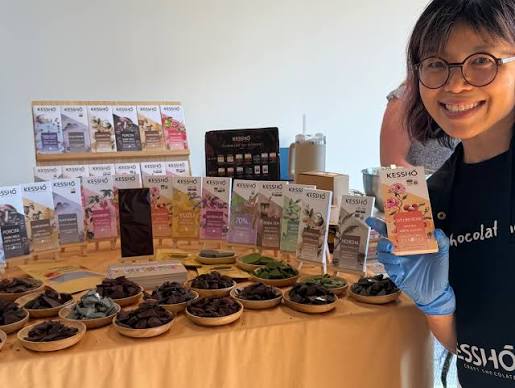
SPECIAL THANKS TO AUSTIN
Last year, Kesshō suffered a major break-in, losing over $5,000 worth of equipment. Liang posted on Instagram about the incident, and the local Austin community stepped up quickly. They helped her reach out to local TV stations for media coverage, also connecting her with the local police department and an Austin council member. All told, the community donated over $3,000 via a GoFundMe campaign, helping Kesshō to get back on their feet quickly (photo from the GoFundMe pictured here).
Liang happily adds, “People also came to buy out our gelato and chocolate from the food truck that weekend which set a single-weekend sales record for us.”
Simple Ingredients
Ever since Liang and Mark started Pie House in Beijing way back in 2009, a few universal truths have powered every culinary venture they’ve created, and Kesshō is certainly no exception.
Liang is a big fan of Japanese Zen philosophy, and the wabi-sabi philosophy as well: less is more. Selecting the very best ingredients is a requirement for Kesshō. They use non-GMO ingredients across the board, while paying close attention to what gives each, individual recipe its character, including for the Japanese teas and black sesame they source. They’re even working on Non-GMO Project verification for their bars.
Liang expands on the rest of Kesshō’s philosophy –
“It all starts with one core philosophy: the chocolate needs to be tasty with simple ingredients. We don’t want anything industrial, nothing people use to hide the defects from bad ingredients.
It’s important that all ingredients remain recognizable, and that they can sing with the cacao bean’s original flavor profile. If chocolate is made with tea or black sesame, we want that flavor to have a clear place in the experience, while people can still tell the origin (outside of white chocolate bars).
We also want the whole piece to be enjoyable to eat – having an unusual flavor combination can’t be its only reason for existence.
Last but not the least, there is a cultural side too. A flavor can be familiar to one person yet completely new to another. Chocolate gives us a way to share ingredients with people who may come to them with very different memories in place.”
Only Source the Best
For these philosophies to ring true, the cacao needs to hold up its end of the bargain, and Kesshō makes sure of it by only working with world class cacao origins. Kokoa Kamili in Tanzania, Semuliki Forest in Uganda, and multiple regions in Ecuador hold serve as the primary cacao origins powering Kesshō Craft Chocolate.
Liang and Mark care deeply about where their cacao comes from and also how it reaches them. Fully transparent sourcing is paramount, and for Kesshō this includes connections with Kokoa Kamili, Latitude Cacao, Meridian Cacao, and Cocoa Supply as well. As Liang notes, “We want the people producing the cacao to be part of the story we tell about our finished chocolate.”
For all their cacao partners, Kesshō receives regular updates, including media of farmers, fermentation, and drying activities.
Liang adds –
“We use a similar approach with many of the premium ingredients used in our chocolate too, such as the Japanese tea and yuzu powder. I know the growers personally, and they taught me how to tell the difference between different grades of products and how to control the temperature when using these ingredients to preserve the best flavor as well.”
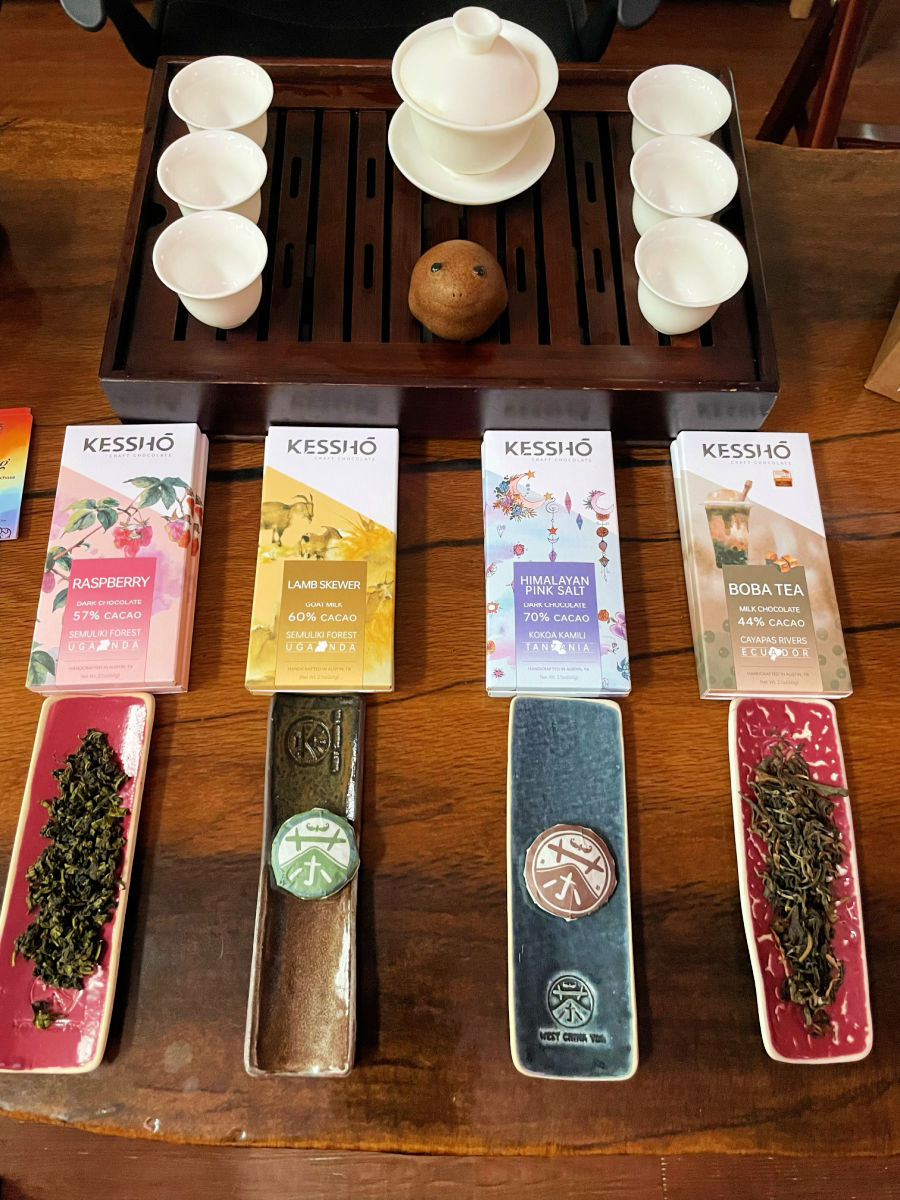
Oh Those Wonderful Combinations…
Now with close to two decades under their belts as culinary creators, Kesshō’s uniqueness shines through brightly in their bean-to-bar chocolate, crafted through the lens of their deep experience with Asian ingredients and pastry. Two concepts in particular lead the way for each and every combination.
First, they use “flavor memories” when creating chocolate recipes. Liang explains –
“A dark molasses sugar and black tea note would remind people of boba tea, and that’s how we made the boba tea chocolate bar. Another perfect example is our Lamb Skewer Bar. When goat milk meets cumin, you think about a lamb skewer, as the gaminess would come through, and this is what one experiences when eating our lamb skewer bar.”
The second concept is to properly pair the perfect cacao for each flavor combination. The choice of chocolate matters as much as the added flavors. Cacao origin changes how the acidity, aroma, or roasted notes come through in each creation.
That’s the magical blueprint behind their award-winning chocolate. Now with that in mind, let’s shine a spotlight on some of the incredible combinations you’ll find in Kesshō’s impressive repertoire.
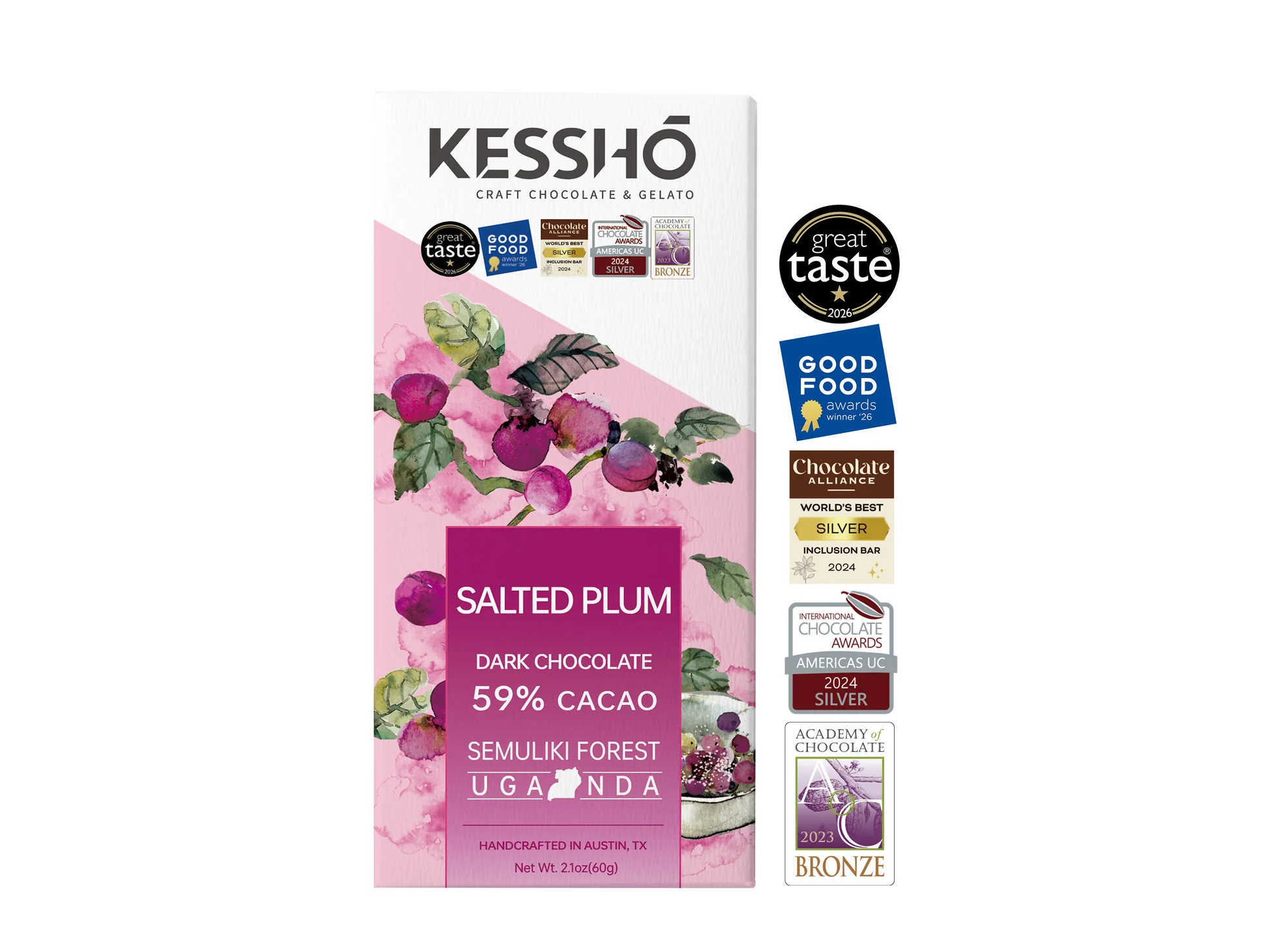
Kesshō Craft Chocolate Salted Plum 59% Dark Bar
This bar is Kesshō’s best seller, and Liang offers her take on why –
“I think people respond to it because the salt and plum combination works well in various countries’ cuisines.
In Japan, salted plum = umeboshi, a household pantry staple that adds aromas to the sushi rice. In China, salted plum = preserved plum, probably the most popular snack across all ages and regions. In the US, people use plum sauce to cook savory dishes to create a balanced flavor profile.
It holds a place in everyone’s hearts and connects the culinary cultural dots across the ocean. One time a lady in Houston emailed us to say that eating the salted plum chocolate bar reminded her of her childhood. When her family had just moved from China to the US, her dad would reward her with salted plum candies hidden in the cabinets. Memories are powerful.”
Salted Plum brings a sweet, sour, and salty combination to the dark chocolate.
Cacao Origin: Semuliki Forest, Uganda
Tasting Notes: Tangy, hint of chocolate-covered raisins, zesty
Ingredients: Whole cacao beans, sugar, cocoa butter, plum powder, salt
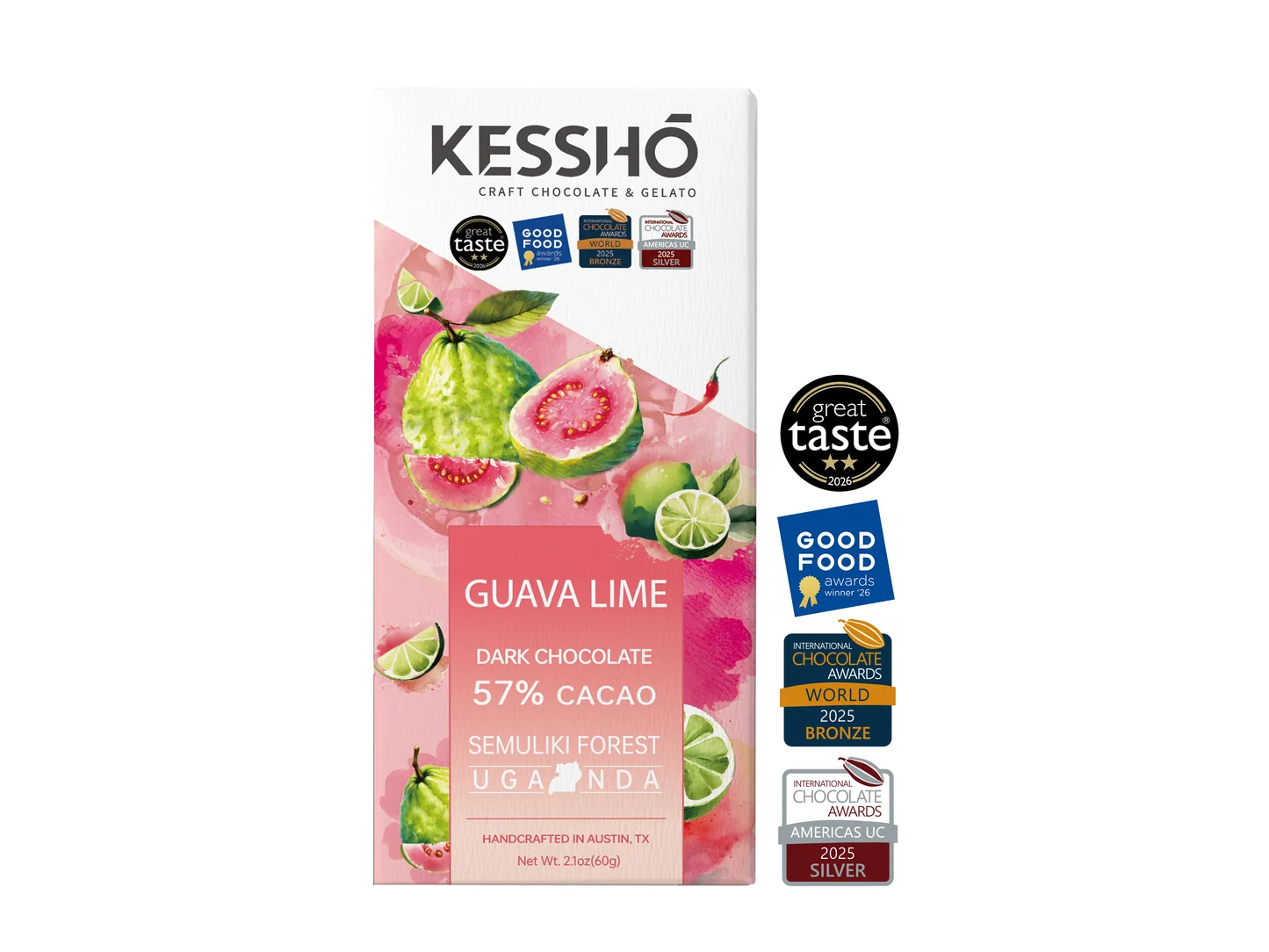
Kesshō Craft Chocolate Guava Lime 57% Dark Bar
“Inspired by Southeast Asian night markets and their chili-sugar dusted guava, this bar blends single-origin Ugandan dark chocolate with bright, tropical guava and a zesty lime twist. The combination of tart fruits and deep chocolate creates a vibrant harmony, with a subtle warmth of chili appearing at the finish — transforming a beloved street snack into a refined chocolate experience.”
Cacao Origin: Semuliki Forest, Uganda
Tasting Notes: Sweet guava, tropical tanginess, warming chili
Ingredients: Whole cacao beans, sugar, cocoa butter, pink guava powder, lime powder, chili powder
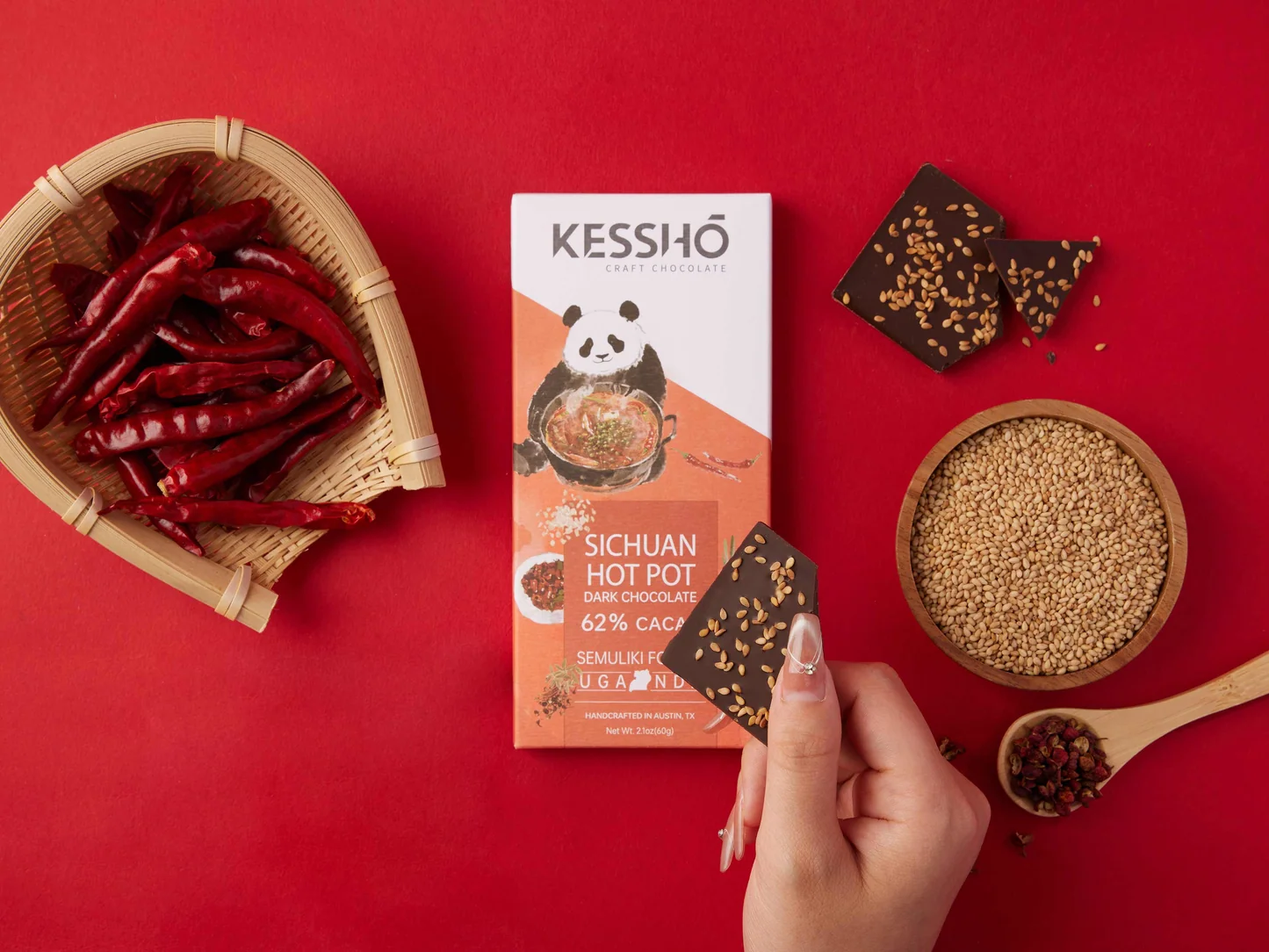
Kesshō Craft Chocolate Sichuan Hot Pot 62% Dark Bar
Kesshō created this bar to “capture the soul of Sichuan hotpot.”
“Aromatic umami and gentle heat keep even spice-shy friends reaching back for more. Ugandan cacao meets fermented black beans, the nutty aroma of toasted white sesame, and the bright lift of spices. A dusting of dry chili and a pinch of sea salt bring it into focus.”
Cacao Origin: Semuliki Forest, Uganda
Tasting Notes: Umami, toasted sesame, nutty spice, numbing pepper
Ingredients: Whole cacao beans, sugar, cocoa butter, roasted white sesame seeds, fermented black beans, Sichuan green pepper powder, chilli powder, sea salt
For the next three bars, Liang appreciates exploring the very different expressions of tea flavors: “Matcha brings green tea intensity; hojicha has a roasted character; genmaicha combines tea with toasted rice.”
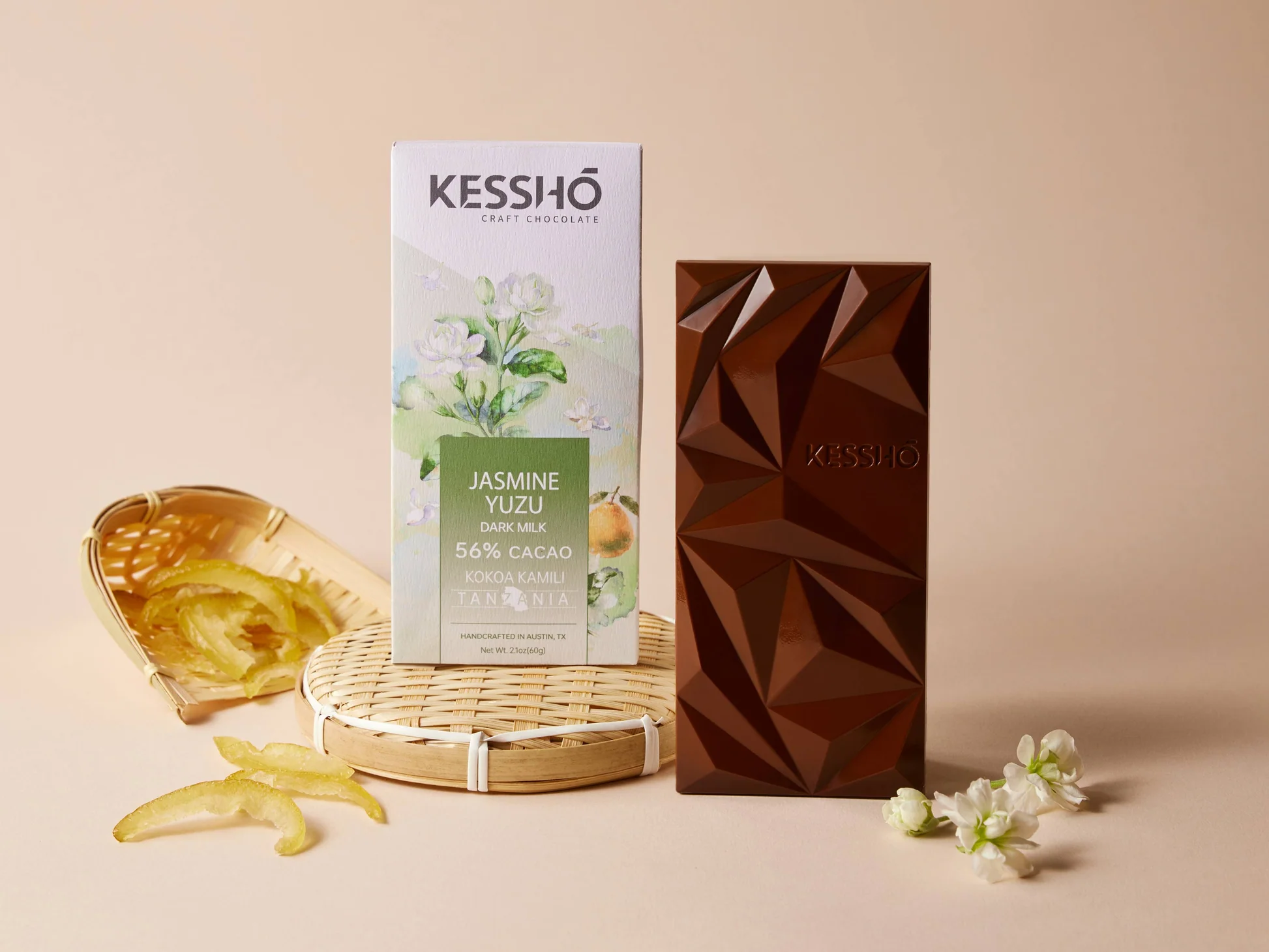
Kesshō Craft Chocolate Jasmine Yuzu 56% Dark Milk Bar
Kokoa Kamili cacao from Tanzania is naturally citrusy and floral, so it’s lightly roasted to keep those flavors intact. Here it’s coupled with two ingredients that run with the cacao, not against it. Jasmine picks up the floral notes, yuzu picks up the citrus.
“The tea is hand-rolled jasmine pearl from Fujian, which has a cleaner, more delicate aroma than conventional jasmine. The yuzu is gently candied, so it lifts the chocolate with a fresh citrus finish instead of a sharp one.”
Cacao Origin: Kokoa Kamili, Tanzania — lightly roasted
Tasting Notes: Jasmine floral aromatics, bright citrus, subtle jujube sweetness, soft green tea finish
Ingredients: Whole cacao beans, cocoa butter, cane sugar, whole milk powder, jasmine tea powder, brown sugar, candied yuzu peel, sea salt
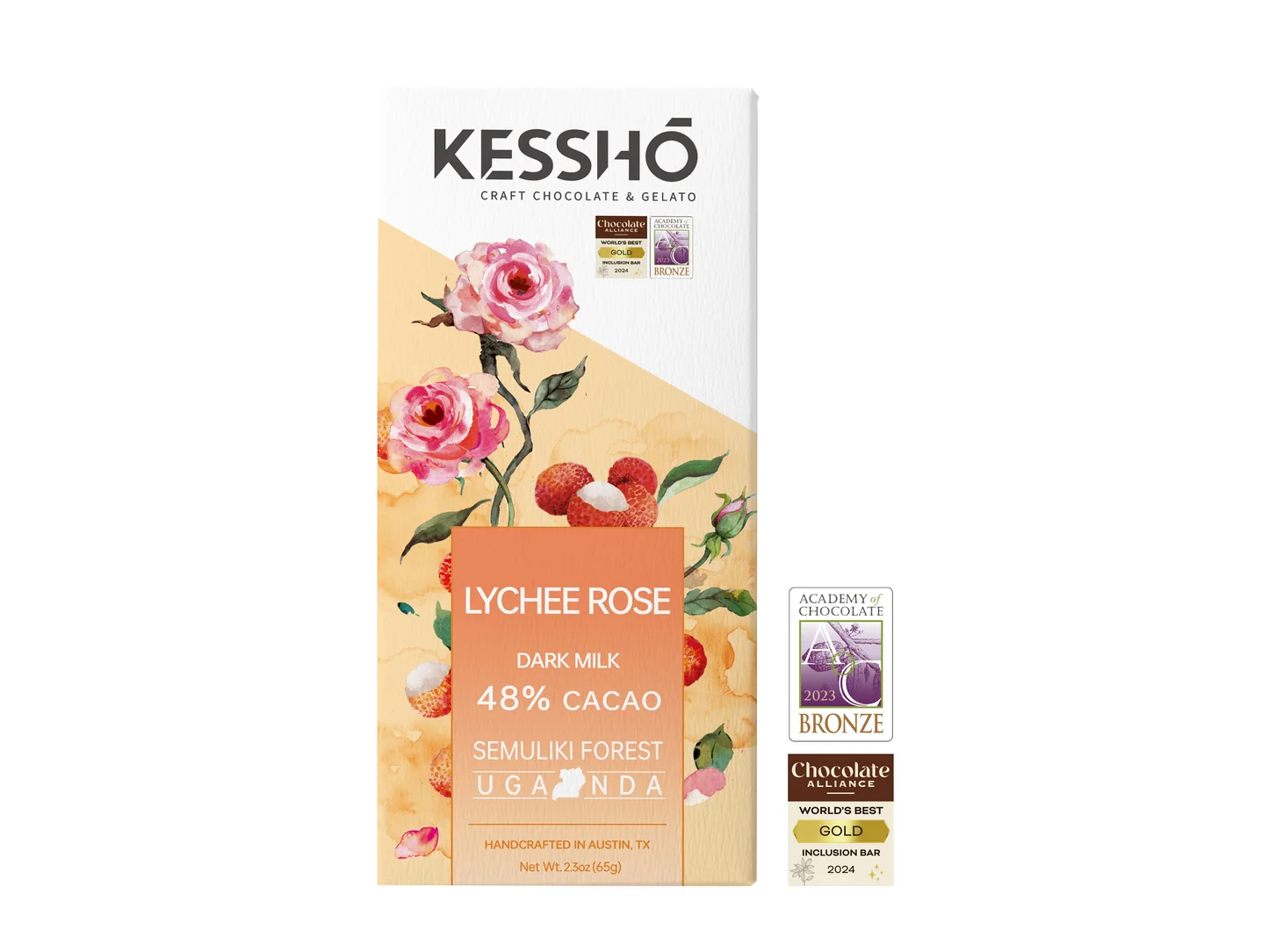
Kesshō Craft Chocolate Lychee Rose 57% Dark Milk Bar
“A burst of floral lychee sweetness melts into creamy dark milk chocolate. Dried lychee pieces intertwine with the velvety texture, accented by gentle notes of rose petal.”
Cacao Origin: Semuliki Forest, Uganda
Tasting Notes: Floral creaminess, lychee chew, rose petal
Ingredients: Whole cacao beans, sugar, whole milk powder, cocoa butter, rose powder, lychee powder, dried lychee
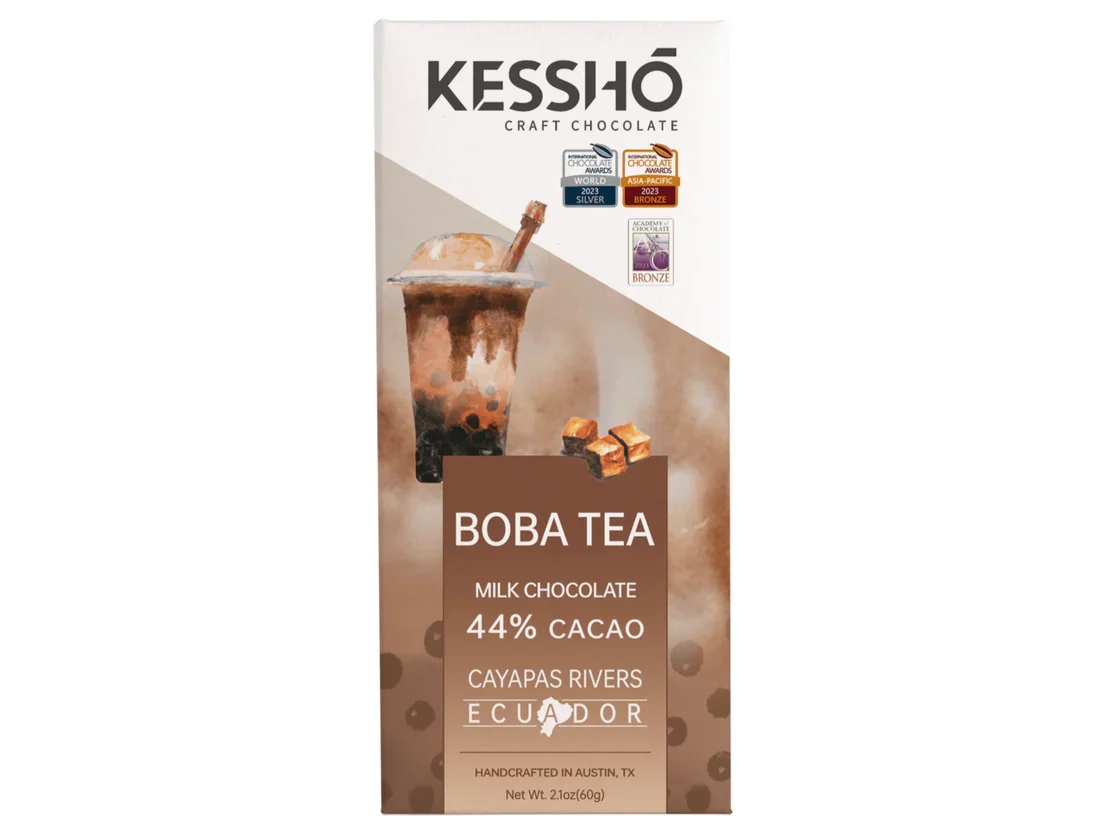
Kesshō Craft Chocolate Boba Tea 44% Milk Bar
Liang holds this bar in high esteem – “Our Boba Tea Chocolate Bar was featured in the NY Times’s holiday gift guide in 2024, which really ignited our direct-to-customer sales.”
Here Kesshō combines black tea sourced from the Fujian Province in southern China with Ecuadorian cacao beans, blending with brown sugar for “a creamy bar built for boba lovers.”
As quoted from the New York Times, “The tea flavor, pleasantly bitter and earthy, achieves an almost orchestral balance.”
Cacao Origin: Cayapas River, Ecuador
Tasting Notes: Boba, caramel, chocolate fudge
Ingredients: Cocoa butter, brown sugar, whole cacao beans, whole milk powder, skim milk powder, black tea powder, sugar, dark brown sugar
Two Very Unique Confections
These two special creations showcase just how well Kesshō competes in any area of the chocolate world.
First, their Black Sesame Butter Cup is another example of taking a familiar confection and interpreting it through a different, beloved ingredient. This ICA Gold Award-winning butter cup features a premium Indian black sesame seed shell blended with organic cocoa butter and sea salt.
The shell surrounds a nut-free sunflower butter and Taiwanese black sesame center that’s sweetened with raw honey. This reinterpreted classic keeps the sweet and the savory in perfect balance.
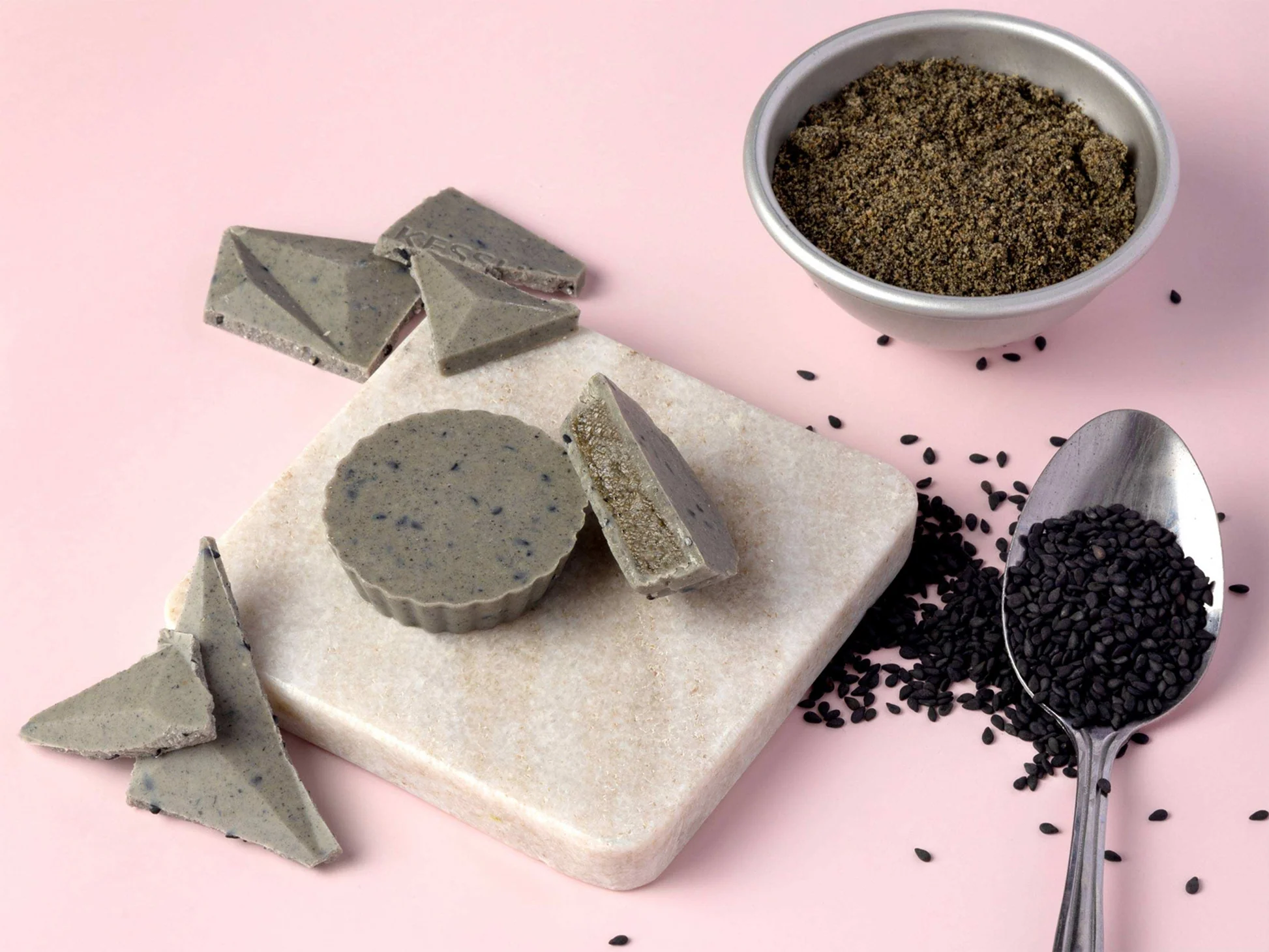
In addition to Gold, the Black Sesame Butter Cups also won Special Prize for Reinterpretation, “recognizing a familiar form rebuilt in another culture’s language.”
As Kesshō notes, “The peanut butter cup is about as American as confectionery gets; ours is built on black sesame instead, an ingredient revered across Asia.”
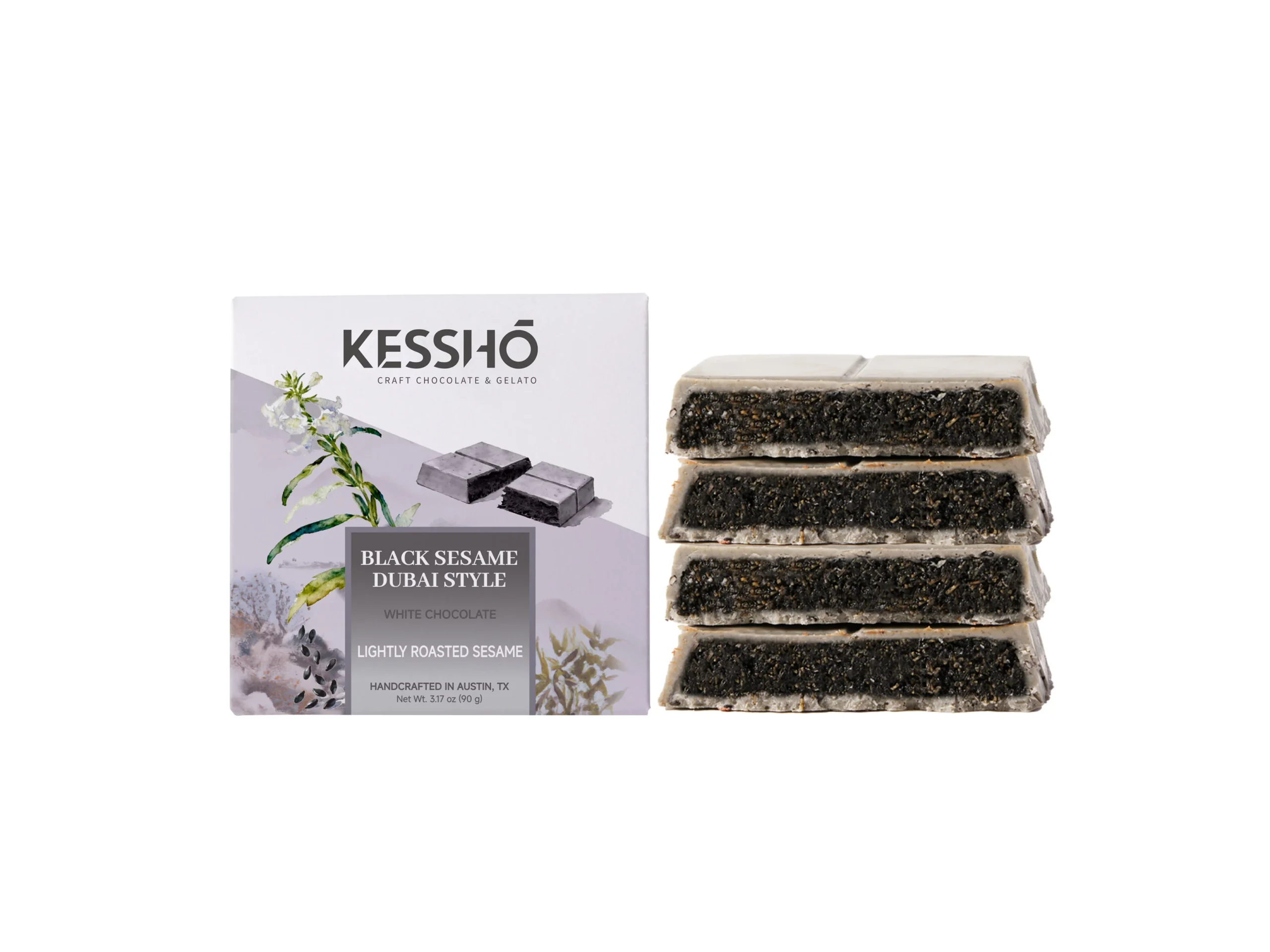
Second, on the heels of the award-winning black sesame butter cups, Kesshō launched the black sesame Dubai bar. The result? Yet another Kesshō creation shared by a New York-based influencer who happened to love black sesame.
The kudos helped the Black Sesame Dubai Bar become popular nationwide. this Dubai-style bar echoes the familiar refrain other chocolate makers have heard over the past couple of years. Liang elaborates –
“We received so many phone calls asking about Dubai bars! We really didn’t want to simply craft something already on the market, so we created something unique here, with our own interpretation.”
That interpretation is built on sesame, not pistachio, and featuries black sesame paste made by Wadaman, a fifth-generation Osaka roaster, widely considered Japan’s finest. “Master roaster Etsuji Wada uses a traditional three-step low–high–low heat process that produces a distinctly aromatic, crisp sesame.”
The bar combines that black sesame paste with toasted kataifi, which is then enrobed in Kesshō’s black sesame white chocolate.
The Award Goes To…
We mentioned how it all started, when Mark and Liang won two awards for a 58% Tanzanian Dark Milk Chocolate Bar they created before even officially launching Kesshō.
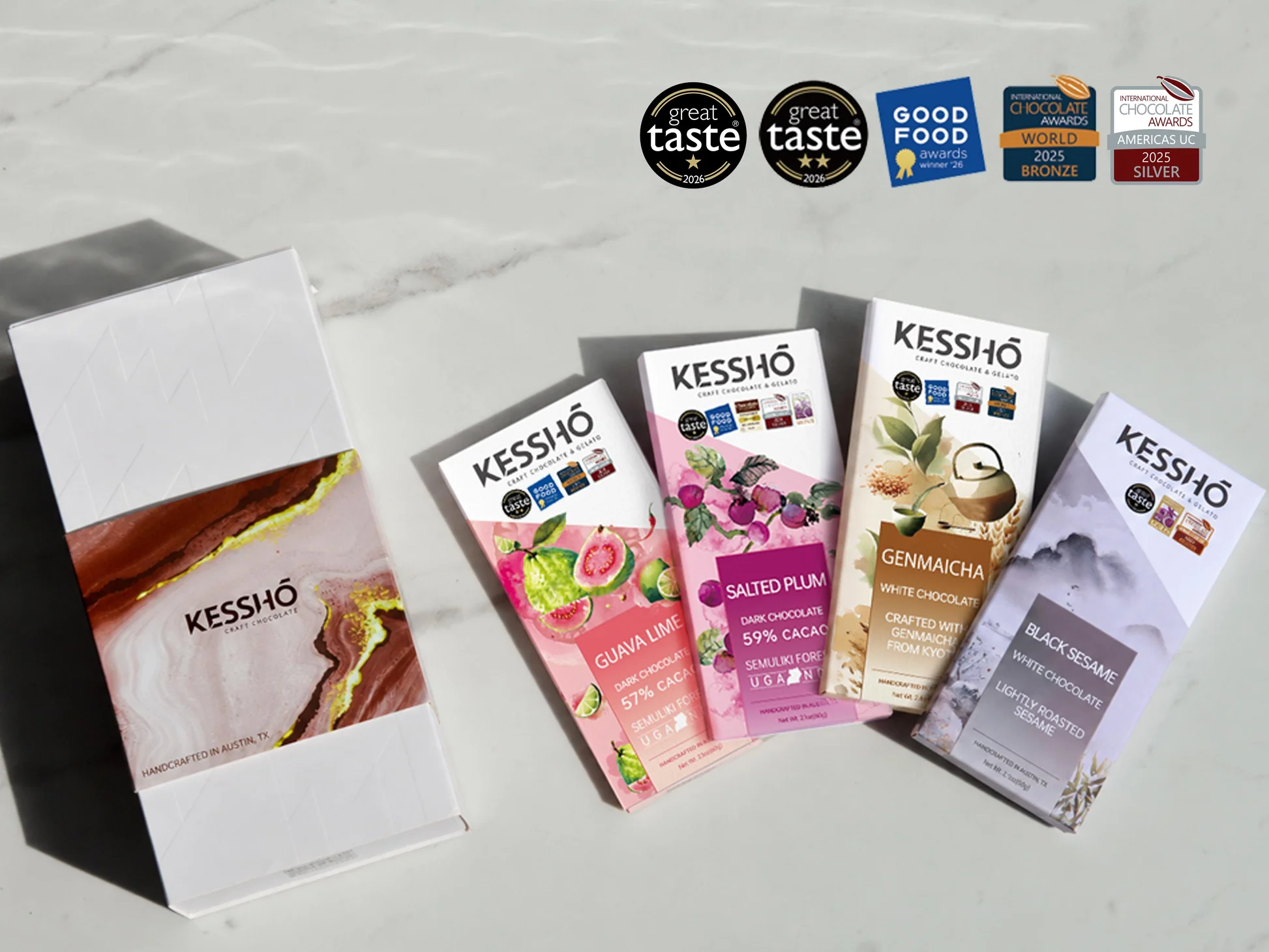
Those two early awards were only the beginning, however, and in 2026 Kesshō really brought home some impressive wins. Guava Lime, Genmaicha, and Salted Plum all received Good Food Awards; then, across the pond at the 2026 Great Taste Awards, Guava Lime received two stars, while Genmaicha, Black Sesame, and Salted Plum each received one star. That’s seven awards across the globe in 2026!
They also won a 2024 Academy of Chocolate Gold for their Black Sesame White Chocolate, the chocolate noted above that’s used in their Dubai-style bars.
Truly a Team Effort
When discussing what lies ahead, Liang won’t even go there before first tipping the cap to the team she works with (and clearly adores) at Kesshō today:
“Our team is a big part of what Kesshō means to me. Technology helps, but making food still takes a lot of hands-on work. It depends on people paying attention and caring about the result.
I feel lucky when I see our production team taking ownership of what we make, or our sales team creating fun content during their shifts.
Running a business can be tiring, but I never feel alone when there are problems to solve. Yes, we’re ordinary individuals, but together we built something much bigger than any one of us could make alone.”
Kesshō manufactures all their own products and operates their own retail spaces too. Liang appreciates the very direct connection everyone has to the work, everything from production records to conversations with customers.
Today, she leads product development, marketing, and sales. Mark runs supply chain, finance, and administration, while also maintaining the equipment. In other words, as Liang puts it, “Mark does all the hard stuff!”
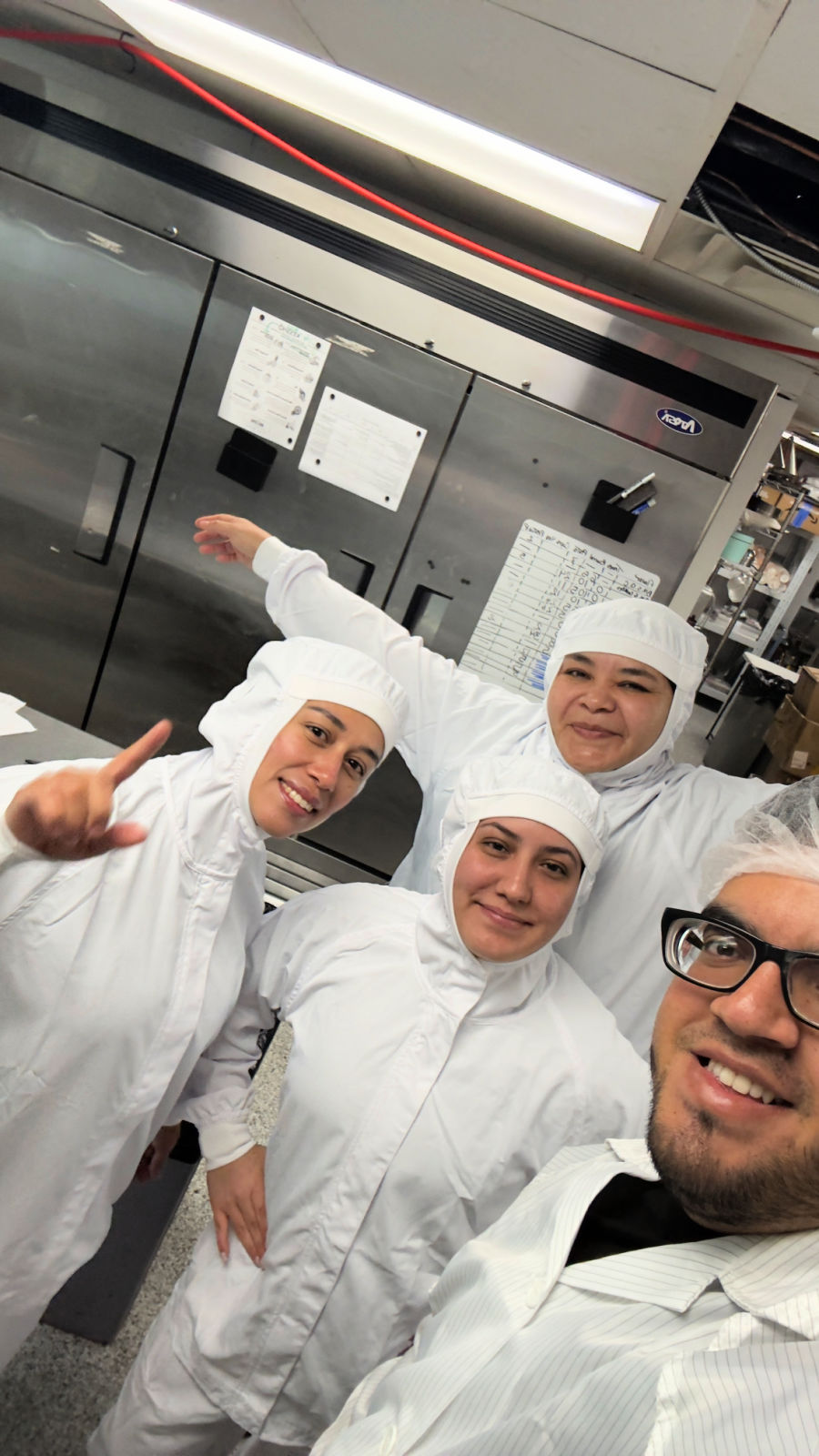
The Kesshō Team at Work in the Chocolate Kitchen
Liang also offers particularly high praise for Kesshō’s general manager, Hui Yu.
“She is a certified IICCT level II chocolate taster and also very, very good at making chocolate. Before joining us, she worked in food industry marketing back in Shanghai, and she first joined our team as marketing director of Kesshō in Shanghai.
When Mark and I moved to Austin, she joined us, and I was truly impressed by how quickly she learned chocolate while also adjusting to life in America. Besides mastering both crafting and tasting chocolate, Hui also learned how to fix some of the equipment! She’s amazing!”
What’s Next for Kesshō?
Liang says their next priority is to make Kesshō easier to find while continuing to improve the work behind every product as well –
“We want to build lasting relationships with specialty retailers and help their teams understand the ingredients and stories behind the chocolate. We’re also continuing to develop our Austin business, where customers can experience our gelato alongside our chocolate.”
She then takes a moment to reflect on the meaning behind the name…
“Kesshō means crystal in Japanese. It refers to chocolate’s crystalline structure and also carries the idea of something that results from hard work… it signifies the rewards that spring from laboring over what you love, embodying our painstakingly precise bean-to-bar process.
Every step of the journey, from selecting organic cacao farms to manufacturing in our boutique factory in Austin, stands as a testament to our dedication. Both meanings feel appropriate for a business where the finished product depends on so much patient work.”
When I ask her what her favorite part of working in the chocolate world is, she answers with ease –
“I love seeing people enjoy our sweets. Asian flavors connect me with communities here and let me share memories with people discovering those flavors for the first time. I absolutely love that!”
Grandma Mo Would Be Proud
Reflecting on Kesshō’s story here, my mind wanders to Liang’s wonderful grandmother, Mo, who played such an important, inspirational role in her life.
Looking at all Liang and Mark accomplished to date, coupled with the outstanding values they bring to the business – from sourcing, to ingredient quality, to the people they work with and employ at the company – I can’t help but think back to Mo and how proud she would undoubtedly be of her granddaughter.
I could be wrong here (I actually didn’t ask Liang about this), but I feel like Kesshō’s gorgeous packaging in a way pays homage to Grandma Mo. The artistry, a watercolor style blended with traditional Chinese painting techniques, clearly reflects the rich diversity of all the carefully selected ingredients inside Kesshō’s creations.
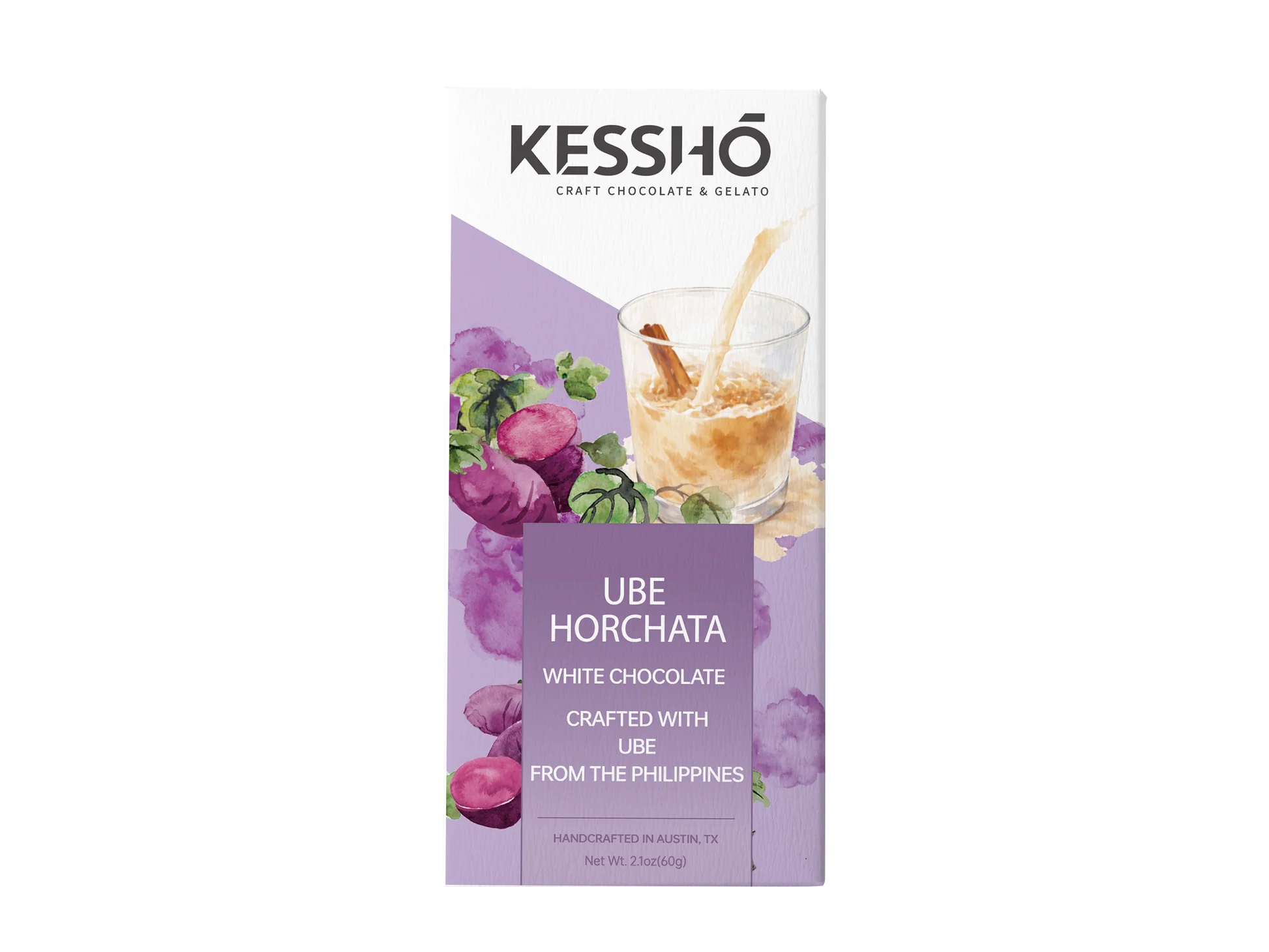
Now when I look at one of Kesshō’s beautiful chocolate bar boxes, I’ll actually think of Mo, particularly with the Ube Horchata Bar. Why? Because it feels perfectly emblematic of Liang’s international chocolate journey. For one, its entire existence stems from one of her first cultural learning moments in America – the woman at Central Market who tasted Hojica, expecting Horchata.
Also, the bar blends Peruvian cacao, Filipino ube, and Hispanic horchata spices. It feels like a wonderful cross culture celebration, harkening back to Liang’s childhood when family would visit her in Beijing from around the world, a cornucopia of international chocolate in tow.
And last of all, because much like I noted before with Liang’s early memories of the wondrous power in that chocolate from visitors – it would readily put smiles upon people’s faces – and I can’t imagine Grandma Mo wouldn’t be smiling right now looking at what Kesshō has become.
Where to Find Kessho
First and foremost, visit the Kesshō store locator, where you can hopefully find their chocolate at a store somewhere near you.
You can also briefly purchase a special Liang-curated selection in our Chocolate Shop here in November ’26, and can of course purchase online at Kesshō’s website anytime as well.
If you’re a chocolate festival attendee, look for Kesshō at the Northwest Chocolate Festival, the PA Chocolate Festival, the Austin and Dallas chocolate festivals, and the San Francisco Coffee Festival as well.
One final note – you may occasionally find Kesshō in some holiday markets in Austin, Houston and New York too.
+ Photos by Kesshō Craft Chocolate